
Can You Study in Germany Straight After Plus Two? What Indian Students Need to Know
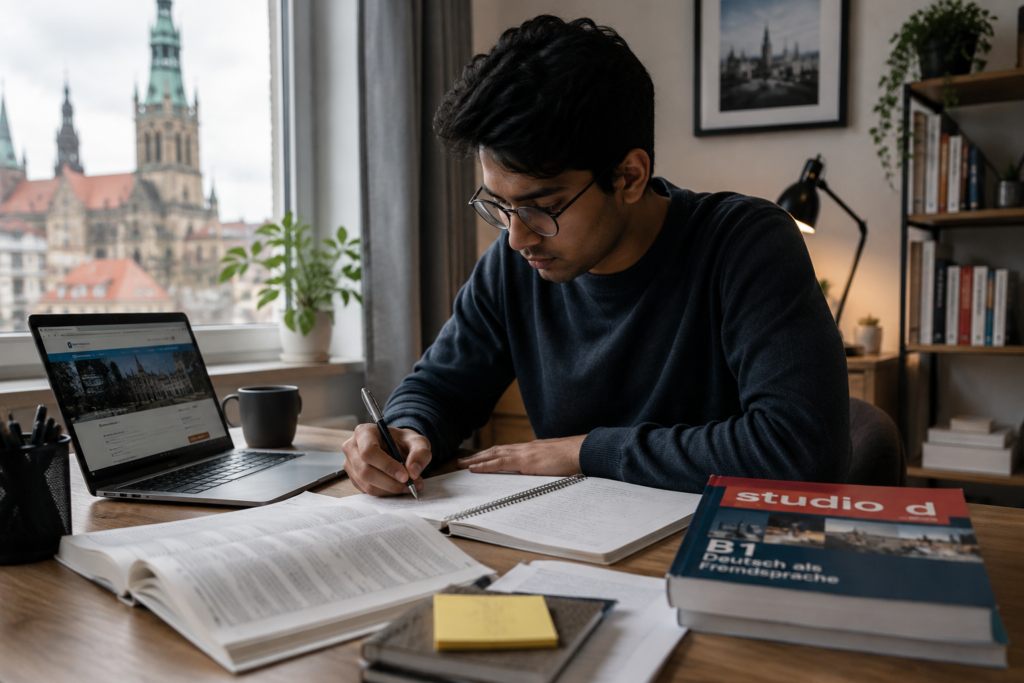
Every year, thousands of families in Kerala begin researching Germany as a study destination the moment their child’s Class 12 results arrive. The logic feels straightforward: German public universities charge little or no tuition, the country is stable and well-connected, and there is a visible community of Keralites already living and working there. But one assumption causes genuine confusion — the idea that a strong 10+2 result is enough to walk straight into a German bachelor’s programme.
It is not. And understanding why, and what the alternatives actually look like, is the most important piece of planning any student and their family can do before going further.
Why Your 10+2 Is Not Automatically Enough
Germany’s school system runs for 13 years before students qualify for university. The final school-leaving certificate, called the Abitur, represents that full 13-year education. India’s 10+2 system, by design, covers 12 years.
That one-year gap is the structural issue. German universities are not making a judgment about the quality of Indian education — CBSE, ISC, and state board qualifications are all considered credible. The issue is a systemic difference in the length and depth of school preparation.
As DAAD India — the German Academic Exchange Service — states clearly on its official guidance page for Indian students: after a Class 12 certificate from Indian, Nepalese, or Bhutanese boards, one cannot get direct admission to a German university (with very limited exceptions).
This is the baseline reality. Everything else follows from it.
The Standard Route: Studienkolleg
The path that most Indian students with a 10+2 qualification take is through a Studienkolleg — a university preparatory course designed specifically to bridge the gap between the Indian school-leaving certificate and German higher education entrance standards.
A Studienkolleg runs for two semesters, roughly one academic year. It is full-time — typically 32 or more hours of classroom instruction per week, Monday to Friday. The language of instruction is German. At the end, students sit for the Feststellungsprüfung (FSP), an examination that, if passed, qualifies them to apply to German bachelor’s programmes.
Passing the FSP does not guarantee university admission — it makes you eligible to apply. Competitive programmes can still have their own selection criteria.
What type of Studienkolleg should you attend?
Studienkollegs are subject-specific. The type you enrol in should match the field you intend to study at university. According to DAAD India, the main course types for universities are:
- T-Kurs: Mathematics, science, or technical degrees
- W-Kurs: Business, economics, and social sciences
- M-Kurs: Medicine, biology, and pharmacy
- G-Kurs: Humanities and German studies
- S-Kurs: Language degrees
For universities of applied sciences (Fachhochschulen), there are parallel tracks: TI for technical and engineering, WW for economics and business, GD for design and art, and SW for social sciences.
Choosing the wrong Studienkolleg can create complications later, so this decision needs to be made early, alongside your field of study.
The Language Reality
Most Studienkollegs conduct their courses in German and require applicants to demonstrate a minimum of B2 level proficiency in German before admission. Some accept B1, but B2 is increasingly standard.
For most students in Kerala who start from zero, reaching B2 typically takes 10 to 14 months of consistent, structured study. That is a significant commitment — and it needs to begin well before the application process, not alongside it.
The Goethe-Institut (Max Mueller Bhavan), which has centres in Kochi, Chennai, and other cities across India, is the most recognised institution for German language learning and certification. Many students combine classroom study at a Goethe centre with independent preparation.
Are There Any Direct-Entry Exceptions?
Yes — but they apply to a small proportion of students.
According to DAAD India, there are a few pathways that allow Indian students to apply directly to a German bachelor’s programme without going through Studienkolleg:
1. IIT-JEE Advanced rank
Students who have qualified in the IIT-JEE Advanced examination may apply directly to German universities for subject-specific programmes in technology and natural sciences. This exception exists because the JEE Advanced is recognised as comparable in rigour to German university entrance standards.
2. One completed academic year at a recognised Indian university
If a student has finished one full year of a bachelor’s degree in India — in a relevant field — they may apply directly to a German university for a subject-specific programme in the same or a closely related field. This pathway is subject-restricted: you cannot use a year of commerce studies to apply directly to engineering, for example.
3. IB or GCE qualifications
Students who have completed the International Baccalaureate (IB) diploma or the British General Certificate of Education (GCE) at the right levels may qualify for direct or subject-specific university entry. These are less common among students from mainstream Kerala boards.
For the overwhelming majority of CBSE, ISC, and Kerala state board students, the Studienkolleg route is the correct path.
The New 70% Minimum — A Change Worth Knowing
From the Winter Semester 2026/27 onwards, a significant policy update has taken effect. Indian applicants for undergraduate studies in Germany must now have a minimum of 70% in their Class XII results to be eligible — both for Studienkolleg admission and for the direct subject-restricted pathway.
This minimum applies regardless of the examining board. Applications submitted before 15 March 2026 are not affected, but all new applications fall under this updated requirement.
This change was noted by studying-in-germany.org in their April 2026 update, reflecting the revised anabin database criteria used by German universities and authorities to assess Indian qualifications.
The practical implication: if a student scored below 70% in their Class 12 boards, the door to Germany at the undergraduate level has effectively closed until they gain further academic credentials.
The APS Certificate: Mandatory and Early
Before applying to any German university or Studienkolleg, all Indian students must obtain an APS certificate (Akademische Prüfstelle, meaning Academic Evaluation Centre). This has been mandatory since October 2022, without exception.
The APS is a joint institution of the German Embassy and DAAD. Its function is to verify the authenticity of your academic documents and assess whether your qualifications meet German university entry standards.
Key facts for Indian applicants, based on information from studying-in-germany.org (updated April 2026):
- Fee: €225 (approximately ₹25,000 at current exchange rates)
- Process: Document-based — no interview required for Indian applicants
- Processing time: 4 to 6 weeks under normal conditions
- Validity: Indefinite once issued — you apply for it once
Importantly, unlike applicants from China and Vietnam, Indian students are not required to attend an in-person interview. The evaluation is conducted based on submitted documents.
Apply for the APS well before your intended university application deadline — 3 months lead time is a sensible buffer to account for any delays.
What It Actually Costs: Figures for Indian Families
One of the most practical questions families ask is: what does all of this cost?
At current exchange rates of approximately ₹111 per euro (based on ECB reference data, May 2026), here is an honest picture:
Blocked account (Sperrkonto): Germany requires student visa applicants to demonstrate they can fund their stay. The current minimum is €11,904 per year — roughly ₹13.2 lakhs — held in a German blocked account. This is not a fee; it is your own money that gets released to you at €992 per month after arrival.
Monthly living costs: DAAD India estimates approximately €1,150 per month for a student in Germany — covering rent, food, transport, health insurance, and other essentials. That is around ₹1.27 lakhs per month. Costs vary by city — Munich and Frankfurt are more expensive; cities in eastern Germany or smaller university towns can be noticeably cheaper.
Studienkolleg tuition: State-funded Studienkollegs typically charge no tuition fees. There is a semester contribution at the associated university — usually around €300 per semester.
Part-time work: International students in Germany are permitted to work up to 120 full days or 240 half-days per year. This is a meaningful supplement — many Indian students in Germany work part-time in hospitality, logistics, or campus-based roles.
For a Kerala family, this is a significant financial commitment. The typical comparison is not just with other European destinations but with the cost of private engineering or management colleges within India, many of which run into ₹15–25 lakhs for a full degree. Germany’s near-zero tuition is a genuine financial advantage, but the setup costs and living expenses are real.
Planning Backwards: A Realistic Timeline
The single biggest mistake students make is treating Germany as a decision that can be acted on quickly. It cannot.
A realistic backward plan from a Winter Semester start (October/November) in Germany looks roughly like this:
- 12–14 months before departure: Begin German language classes. Aim for B2 before application.
- 8–10 months before: Apply for the APS certificate. Gather all academic documents.
- 6–8 months before: Begin applying to Studienkollegs (deadlines vary by institution; many use uni-assist.de for applications).
- 4–6 months before: Receive admission offer, begin visa application. Arrange blocked account.
The process rewards those who plan early and penalises those who start late. Language preparation, in particular, cannot be compressed.
A Broader Perspective
Germany is not the easiest European study destination to access at the undergraduate level. The Studienkolleg route adds approximately one year to the journey, and the language requirement is genuine — not a formality. For students who are willing to prepare seriously, the investment pays off. Public university education is largely tuition-free, the post-study work visa allows up to 18 months to find employment after graduation, and India–Germany academic interest has grown substantially: Germany now hosts over 400,000 international students, with Indians among the top groups.
But the path requires honesty. A family that understands the actual requirements — the language, the Studienkolleg year, the financial setup, the APS process — is far better positioned to make a good decision than one working from incomplete information.
Germany rewards preparation. It does not reward assumptions.
Conclusion
For most Indian students finishing 10+2 from CBSE, ISC, or Kerala’s state board, there is no shortcut to a German bachelor’s programme. The Studienkolleg exists precisely to bridge this gap — and it is a well-established, legitimate route taken by many thousands of international students each year. Understanding what it involves, when to start preparing, and what the real costs look like is the most useful thing a student or family can do before committing to this path.