
Why Germany Is Still the Best Place for Indian Engineering Students
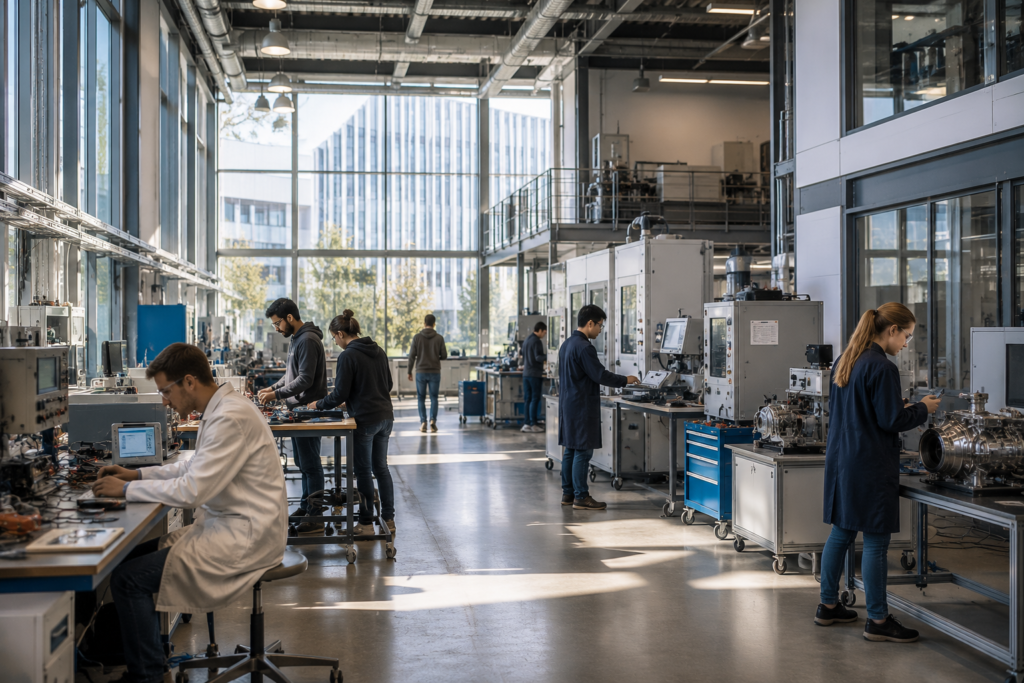
There is a version of Germany that sounds like it used to work — affordable universities, world-class engineering programmes, a clear path into the job market — and a newer, more complicated version where fees have appeared, competition is sharper, and the landscape feels harder to read.
Both versions are partly true. But for Indian engineering students who look past the noise, the underlying logic of studying engineering in Germany remains intact. The pipeline that takes a student from a German university into the German industrial economy still functions. And for a Malayalee family making a considered, long-term decision about education abroad, that matters more than whether the conversation has become more complex.
This article looks at what that pipeline actually looks like in 2026 — what it costs, where it leads, and why the structural opportunity hasn’t gone away.
India Has Already Noticed
The scale of Indian interest in German higher education is not a matter of opinion. According to DAAD (Deutscher Akademischer Austauschdienst — Germany’s national agency for international educational exchange), there were 59,419 Indian students enrolled at German universities in the winter semester 2024/25. That makes India the single largest source country for international students in Germany, representing a 20 percent increase over the previous year alone.
DAAD also reports that 43 percent of international students aiming to graduate in Germany are enrolled in engineering programmes. These are not students passing through — they are students completing degrees, sitting for exams, doing internships, and entering the labour market.
This is not a trend fuelled by hype. It is a trend fuelled by outcomes.
The Two Universities That Define the Conversation
When Indian families and students research engineering in Germany, two universities dominate early conversations: the Technical University of Munich (TUM) and the Karlsruhe Institute of Technology (KIT). Both are consistently ranked among Europe’s leading technical universities. Both have significant international student populations. But they operate differently, and the distinctions matter.
Technical University of Munich
TUM is a flagship institution — it appears in global top-50 engineering rankings, has strong industry ties across automotive, aerospace, and digital engineering, and is located in Munich, one of Germany’s most economically active cities.
Starting from the winter semester 2024/25, TUM introduced tuition fees for students from non-EU countries. For Master’s degree programmes, these fees are typically €4,000 or €6,000 per semester, depending on the programme. At the current exchange rate of approximately 1 EUR = ₹111 (as of May 2026), that translates to roughly ₹4.4 lakh to ₹6.6 lakh per semester.
This is a significant change. For many years, one of Germany’s core advantages was tuition-free education for all students, including internationals. TUM’s move marks a departure from that in Bavaria, and families planning finances around older assumptions need to account for this.
TUM does offer waiver scholarships for international students, and eligible applicants can apply through the university’s financial aid processes. But the headline cost has shifted.
Karlsruhe Institute of Technology (KIT)
KIT, located in Karlsruhe in the state of Baden-Württemberg, offers a different cost structure. International students from outside the EU pay €1,500 per semester in tuition fees — considerably lower than TUM. At current rates, that is approximately ₹1.7 lakh per semester.
KIT has actively expanded its English-language engineering offerings. A Bachelor’s programme in Mechanical Engineering (International) is taught entirely in English and includes specialisations in Applied Materials, Energy, Global Production Management, and Mobility Systems. From 2025, KIT added three new English-taught Master’s programmes: Mechatronics and Information Technology, Electrical Engineering and Information Technology, and Computer Science.
For an Indian engineering student deciding between prestige and affordability, KIT represents a meaningful middle path — strong academic reputation, lower fees, and growing English-language options.
The Cost of Studying in Germany: A Realistic Picture
Beyond tuition, every international student applying for a German student visa must demonstrate financial sufficiency. This is done through a blocked account — called a Sperrkonto in German — a dedicated bank account where funds are held and released monthly to the student.
As of 2026, the German government requires a minimum of €11,904 per year in a blocked account — equivalent to approximately ₹13.2 lakh per year at current rates. This covers living costs: accommodation, food, transport, and health insurance. It does not include tuition.
For a Malayalee family thinking in terms of total investment, a realistic annual spend at a university like KIT — tuition plus living costs — sits around ₹16–18 lakh per year. At a university like TUM with higher fees, the total rises significantly.
This is comparable to, and in some cases more affordable than, private engineering colleges in India when accounting for quality, international exposure, and post-graduation earning potential. Many families in Kerala are already spending ₹15–20 lakh per year for private professional education without the same outcomes or mobility.
Students may also work part-time during their studies. International students in Germany are permitted to work up to 120 full days or 240 half-days per year, which helps offset living costs without requiring formal work authorisation.
The Part That Actually Matters: What Happens After
The reason Germany’s engineering pathway holds up in 2026 is not just about the quality of the degree. It is about what the degree connects to.
Germany’s economy runs, in significant part, on its industrial sector. This includes automotive companies, machine manufacturers, electronics firms, energy technology companies, and a large network of what Germans call the Mittelstand — mid-sized, often family-owned industrial firms that form the backbone of the country’s export economy. Engineers are not peripheral to this system. They are central to it.
According to Make it in Germany — the German Federal Government’s official portal for qualified professionals — approximately 76,000 engineering vacancies remained unfilled in Germany in 2025. As of 2025, 120,702 engineers of foreign nationality were working in Germany, with 71,146 of them coming from outside the European Union.
The ifo Institute, which tracks business conditions across Germany, reported in February 2026 that 19 percent of companies in mechanical engineering still reported a shortage of skilled workers — even as the broader economy has been in a period of slower growth. The structural shortage, driven by an ageing workforce and decades of underinvestment in technical education, is unlikely to resolve quickly.
For an engineering graduate who completes a degree in Germany, the post-study pathway is clear. Under German law, international students who graduate from a German university are entitled to an 18-month residence permit to search for employment. Unlike a standard job-seeker visa, graduates can work without restriction during this period — including in relevant technical roles — giving them time to transition directly into the labour market.
Entry-level engineering roles in Germany typically start at around €45,000–€55,000 gross per year (approximately ₹50–61 lakh annually at current rates) for mechanical and electrical engineers. With three to five years of experience, that figure rises substantially, and engineers in senior or specialised roles can earn significantly more.
What the Data Tells Us
A few numbers worth holding together:
- India sends the most international students to Germany of any country — 59,419 in 2024/25 (DAAD)
- Germany and India have 505 active higher education partnerships as of September 2025 (DAAD)
- 209,200 STEM professionals were in shortage as of September 2024, a figure expected to grow as retirements accelerate (IW/BDA, reported via Confederation of German Employers’ Associations)
- Engineering graduates can stay 18 months post-graduation to find work — and can work during that period (BAMF)
- The financial requirement for a student visa is €11,904 per year — roughly ₹13.2 lakh (DAAD, 2026)
Each of these facts connects to a larger reality: Germany is not simply an option. For Indian engineering students who approach it seriously, it is a structured pathway into a high-demand, high-income professional field within one of Europe’s most stable economies.
A Note on Language and Preparation
One concern that comes up frequently — particularly among students and families in Kerala — is German language proficiency. The short answer is: many Master’s programmes in engineering at German universities are taught in English, and it is possible to complete a degree and find employment in technical roles without advanced German. KIT’s new English-medium programmes are a good example.
That said, German language skills make daily life easier and open more doors in the job market — particularly in companies that are not internationally focused. Learning even basic German before arriving, and continuing with it during the degree, is consistently recognised as a significant advantage.
DAAD maintains a comprehensive scholarship database that Indian students can search by field and level. Several scholarships for Indian students pursuing technical degrees in Germany exist under this umbrella, worth exploring early in the application process.
The Bigger Picture
It would be easy to look at Germany’s recent shift — particularly the introduction of tuition fees at TUM — and conclude that the country’s advantage for Indian students is shrinking. But that reading misses the structural story.
The fees at German universities, even at TUM, remain far below what a comparable private-sector engineering education costs in countries like the United Kingdom, Australia, or the United States. The post-graduation employment pathway is more direct. The demand for engineers in the German economy is not a short-term trend — it is a demographic and industrial reality that will persist for years.
For a family in Kerala weighing the options carefully (ഓരോ കാര്യവും ശ്രദ്ധയോടെ — as most Malayalee families do), Germany’s engineering pathway offers something that many alternatives do not: a clear connection between the degree and the career, at a cost that makes long-term financial sense.
That pipeline still works. And in 2026, it is drawing more Indian engineering students than ever before.